
The Power of Strategy: Turning Digital Ideas Into Action
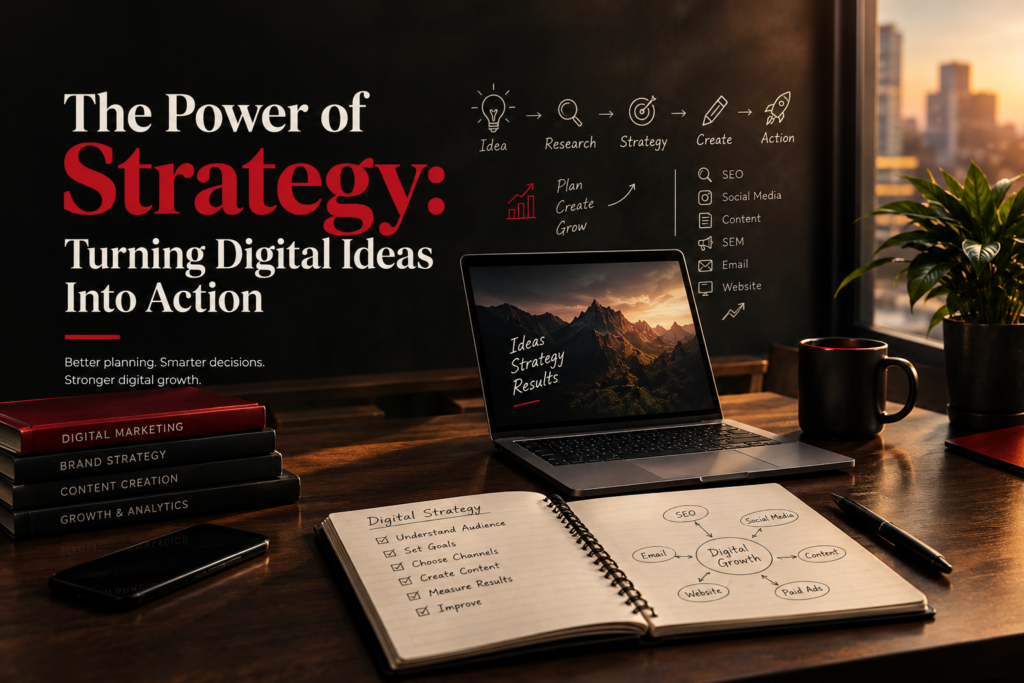
Introduction
Every digital journey begins with an idea.
Maybe it is an idea for a new business, a social media campaign, a website, a product launch, or a new way to connect with customers. Ideas are everywhere, but not every idea becomes meaningful.
The difference often comes down to strategy.
In digital marketing, strategy is what transforms creativity into purposeful action. It helps a brand understand where it is going, who it wants to reach, what it wants to communicate, and how it can measure progress.
For me, digital marketing is not simply about creating posts, choosing keywords, or running advertisements. It is about connecting different ideas and digital channels to create a clear and meaningful experience for an audience.
A good strategy creates the direction. Creativity brings the idea to life. Consistent action helps move it forward.
What Is Digital Marketing Strategy?
Digital marketing strategy is a structured approach to achieving a business or brand goal through digital channels.
It can include areas such as:
- Search Engine Optimization (SEO)
- Social media marketing
- Content marketing
- Search Engine Marketing (SEM)
- Email marketing
- Website development and optimization
- Paid advertising
- Brand communication
- Analytics and performance tracking
These channels can work independently, but they become more meaningful when they are connected by a common objective.
For example, a business may use SEO to improve search visibility, social media to build awareness, content to educate its audience, and paid advertising to reach specific customer groups.
The strategy connects these activities instead of treating them as separate tasks.
Why Good Ideas Need Direction
Creativity is one of the most valuable parts of digital marketing. A creative idea can capture attention and make a brand memorable.
But creativity without direction can become inconsistent.
Imagine a business posting interesting content every day but without knowing who the content is for or what the business wants to achieve. There may be activity, but there may not be a clear purpose behind it.
Strategy provides that purpose.
Before asking, “What should we post?” it can be more useful to ask:
“Why are we creating this?”
That simple question can change the way a brand approaches its digital presence.
Start With the Goal
Every strategy needs a destination.
Different businesses may have different objectives. Some may want to increase awareness, while others may focus on website traffic, enquiries, sales, engagement, or building a stronger brand identity.
A goal gives the marketing process something to work toward.
For example:
Goal: Improve online visibility.
Possible actions could include:
- Keyword research
- SEO optimization
- Helpful blog content
- Local SEO
- Social media awareness
- Website improvements
The important point is that the activities should support the goal.
Understanding the Right Audience
One of the most important parts of digital strategy is understanding the people behind the numbers.
A target audience is not just an age group or location. It can include their interests, problems, questions, habits, expectations, and reasons for choosing one brand over another.
Audience research can help answer questions such as:
- What problems are people trying to solve?
- What are they searching for online?
- Which platforms do they use?
- What type of content catches their attention?
- What information do they need before making a decision?
- What makes them trust a brand?
When these questions are understood, marketing communication can become more relevant.
Research Before Creating
Good digital marketing usually starts before the first post is designed.
Research can provide the foundation for better decisions.
This may include:
- Competitor research
- Keyword research
- Audience research
- Market research
- Social media analysis
- Website analysis
- Content research
- Search trend analysis
Research does not mean copying competitors.
Instead, it helps identify opportunities, understand the environment, and discover ways a brand can communicate differently.
A little research before execution can prevent a lot of unnecessary work later.
Turning Research Into a Plan
Once the research is complete, the next step is creating a practical plan.
A plan can define:
What — What will we communicate?
Who — Who are we communicating with?
Where — Which platforms will we use?
When — When will the content or campaign run?
Why — What purpose does each activity serve?
How — How will success be measured?
This creates structure without limiting creativity.
A good plan should provide enough direction to maintain consistency while remaining flexible enough to adapt.
Strategy and Content
Content becomes more powerful when every piece has a purpose.
A blog can answer a search query.
A social media post can introduce a brand.
A video can explain a product.
An email can maintain a relationship.
A landing page can guide visitors toward an action.
Instead of creating content simply to stay active, brands can think about what each piece is helping them achieve.
This approach can make content more useful for both the audience and the business.
The Role of SEO
SEO is an important part of many digital strategies because search engines can connect people with information, products, and services they are already looking for.
A basic SEO strategy may include:
- Keyword research
- Search-friendly content
- Website structure
- Page optimization
- Internal linking
- Technical improvements
- Local SEO
- Helpful and relevant information
But SEO is not only about adding keywords.
The content should genuinely help the person who finds it.
When users can easily understand a website and find useful information, the digital experience becomes stronger.
Social Media With Purpose
Social media can be a powerful way to communicate a brand’s personality and connect with an audience.
But social media strategy is more than posting regularly.
A brand can consider:
- Content pillars
- Visual identity
- Posting consistency
- Audience engagement
- Educational content
- Promotional content
- Behind-the-scenes content
- Community interaction
- Performance analysis
Different content types can serve different purposes.
A balanced approach can help a brand communicate rather than simply broadcast.
Paid Advertising and Strategy
Paid advertising can help brands reach specific audiences and test different messages.
However, advertising alone does not guarantee meaningful results.
The strategy should consider the audience, offer, creative, landing page, budget, and measurement process.
A campaign should have a clear purpose.
For example, an advertisement designed to generate website traffic may use a different message from one designed to generate enquiries.
The creative idea, audience, and objective should work together.
The Human Side of Digital Marketing
Behind every search, click, view, and interaction is a person.
This is easy to forget when digital marketing becomes focused on dashboards and numbers.
People want useful information. They want clear answers. They want brands that understand their needs.
That is why human communication still matters.
A brand can use technology and data while maintaining a genuine voice.
For me, this is one of the most interesting parts of digital marketing finding the balance between technology, creativity, strategy, and human connection.
From Idea to Action
The journey from an idea to execution can be simple when broken into stages.
1. Identify the idea
What are we trying to achieve?
2. Define the objective
What would success look like?
3. Understand the audience
Who are we trying to reach?
4. Research
What information can guide the decision?
5. Build the strategy
Which channels and activities make sense?
6. Create
Develop the content, campaigns, visuals, and experiences.
7. Launch
Put the strategy into action.
8. Measure
Review relevant performance indicators.
9. Improve
Use what was learned to make the next action better.
This process turns a creative thought into something practical.
What Strategy Means to Me
Behind every search, click, view, and interaction is a person.
This is easy to forget when digital marketing becomes focused on dashboards and numbers.
People want useful information. They want clear answers. They want brands that understand their needs.
That is why human communication still matters.
A brand can use technology and data while maintaining a genuine voice.
For me, this is one of the most interesting parts of digital marketing finding the balance between technology, creativity, strategy, and human connection.
The Future of Digital Strategy
Digital marketing will continue to evolve.
Artificial intelligence, automation, changing search behaviour, new platforms, and changing customer expectations will influence how brands communicate online.
But some fundamentals will remain important:
- Understand the audience.
- Start with a clear purpose.
- Create useful experiences.
- Communicate consistently.
- Measure meaningful actions.
- Learn from results.
- Adapt when necessary.
Technology may change the tools we use, but strategy continues to provide the direction.
Conclusion
A digital idea is only the beginning.
To turn that idea into meaningful action, it needs purpose, research, planning, creativity, execution, and continuous improvement.
A strong strategy does not promise that everything will work perfectly. Instead, it creates a clear process for making decisions, learning from results, and moving forward.
For me, digital marketing is about bringing these elements together — understanding people, exploring ideas, building strategies, creating useful content, and turning plans into real digital experiences.
Ideas create possibilities. Strategy gives them direction. Action brings them to life.
That is the power of strategy in digital marketing.