
Behind the Work: My Creative Process
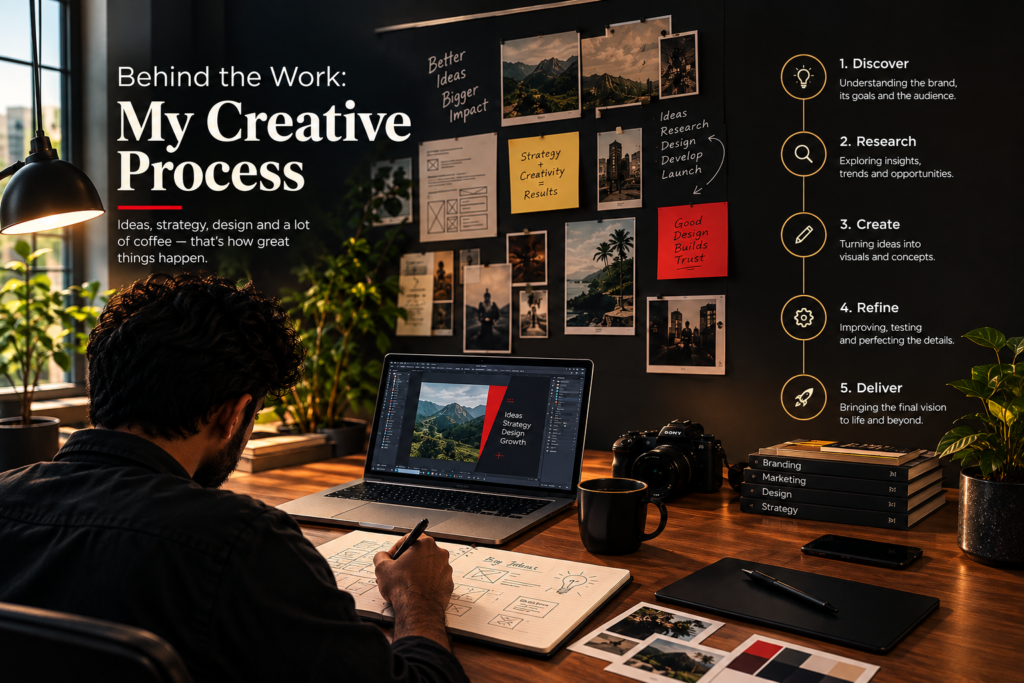
Introduction
Every successful digital experience begins with a thought—a problem that needs solving, an idea waiting to be developed, or a vision that deserves to be brought to life.
But turning that thought into something powerful requires more than creativity alone. It requires research, strategy, experimentation, design, and continuous refinement.
For me, every project begins by asking one important question:
“What should this experience make people think, feel, and do?”
That question guides everything that follows.
My creative process is designed to combine strategy with creativity, ensuring that every website, campaign, content piece, and digital experience has a clear purpose behind it.
01 Starting With the Idea
Before opening a design tool or writing the first line of content, I start with the idea.
What is the brand trying to communicate? What makes it different? What problem is it solving? And most importantly, why should the audience care?
I believe the strongest creative work comes from understanding the idea deeply before trying to make it visually impressive.
A clear idea becomes the foundation for everything else.
02 Understanding the Brand
Every brand has its own personality.
Some brands are bold and energetic. Others are minimal, sophisticated, traditional, or highly innovative.
I take time to understand that personality before developing the creative direction. I look at the brand’s values, positioning, audience, goals, tone of voice, and visual identity.
This allows me to create work that feels authentic rather than simply following a popular design trend.
03 Research Before Creativity
Creativity becomes stronger when it is supported by research.
I study the target audience, competitors, industry trends, customer behavior, and the digital space in which the brand operates.
This research helps answer important questions:
- What does the audience actually need?
- What are competitors doing?
- Where are the opportunities?
- What visual styles are becoming overused?
- How can the brand create a stronger impression?
Research gives me the direction to create something that is not only attractive but also relevant.
04 Turning Research Into Strategy
Once I understand the brand and its audience, I begin building the strategy.
This is where scattered ideas start becoming a clear direction.
I define the communication approach, content structure, visual language, user journey, and overall digital experience.
The objective is simple:
Every creative decision should have a purpose.
A headline should communicate.
A visual should attract attention.
A layout should guide the user.
A call-to-action should encourage movement.
When every element works together, the experience becomes much more powerful.
05 Finding the Visual Direction
Now comes one of my favorite stages—bringing the strategy to life visually.
I explore typography, color palettes, imagery, layouts, shapes, spacing, animation, and other visual elements.
I don’t try to add everything at once.
Instead, I look for the right balance between simplicity and personality.
The goal is to create a visual identity that feels distinctive while remaining clear and easy to understand.
06 Designing for People
A beautiful design is valuable, but a beautiful design that people cannot understand is not effective.
That is why user experience plays an important role in my creative process.
I think about how someone will experience the project for the first time.
Where will their eyes go?
What will they understand first?
What will make them continue?
What could confuse them?
Every section should have a reason to exist and every interaction should feel intentional.
07 Content That Connects
Design may capture attention, but content creates connection.
I focus on creating messaging that feels clear, human, and relevant to the audience.
Instead of filling a website with complicated marketing language, I believe in communicating ideas in a way that people can quickly understand and remember.
The right words combined with the right visuals can turn a simple message into a memorable brand experience.
08 Experimentation Is Part of the Process
Not every idea works on the first attempt.
Sometimes the first concept feels right. Sometimes it leads to an entirely different direction.
I believe experimentation is an important part of creativity.
I explore different layouts, concepts, headlines, visual treatments, and approaches until I find something that feels right for the brand.
The process is not about getting everything perfect immediately.
It is about discovering what works best.
09 Refining the Details
Once the main concept is established, I focus on the details.
Spacing. Typography. Alignment. Contrast. Image placement. Button positioning. Visual hierarchy.
These details might seem small, but together they can completely change how a digital experience feels.
I review the work carefully and remove anything that feels unnecessary.
Good design attracts attention. Great design knows where attention should go.
10 Testing the Experience
Before considering a project complete, I look at it from the audience’s perspective.
Does the message make sense?
Is the navigation intuitive?
Does the design communicate the brand effectively?
Does the experience work across different screen sizes?
Are the important actions easy to find?
These questions help transform a creative concept into something practical and functional.
11 Learning From Every Project
Every project teaches me something new.
A new industry introduces a different audience. A challenging brief introduces a new way of thinking. A design problem can lead to a completely unexpected creative solution.
I don’t see projects as isolated pieces of work.
I see them as opportunities to improve my process, expand my perspective, and become a better creative professional
12 Creativity With a Business Purpose
One of the biggest lessons I’ve learned is that creativity should always connect back to a goal.
A website should not exist simply because a business needs a website.
A campaign should not exist simply because a brand needs content.
Every digital experience should contribute to something bigger—visibility, trust, engagement, leads, sales, recognition, or long-term brand growth.
That is why I combine creative thinking with strategic marketing.
The result should not only look impressive.
It should work.
13 The Final Touch
The final stage is where everything comes together.
The strategy, content, visuals, user experience, and brand personality should feel like one complete story.
I step back and look at the project as a whole.
Does it feel consistent?
Does it feel memorable?
Does it communicate the right message?
Does it represent the brand?
If the answer is yes, the project is ready to move from concept to experience.
What My Process Really Means
My creative process is not a fixed formula.
Every brand is different, every audience is different, and every challenge requires a different approach.
What remains consistent is the mindset behind the work:
Understand first. Strategize second. Create with purpose. Refine relentlessly.
That approach allows me to create digital experiences that feel intentional rather than ordinary.
Conclusion
Behind every polished website, campaign, or digital experience is a process that people rarely see.
There are questions, research, sketches, experiments, revisions, decisions, and countless small details that eventually become one finished experience.
For me, that is where the real creativity happens.
It is not simply about making something look good.
It is about taking an idea, understanding its purpose, giving it a clear direction, and transforming it into something that people can see, understand, remember, and connect with.
Because the best digital experiences aren’t just designed—they are thoughtfully crafted with purpose.